I’ve had a front-row seat to the ad agency world for a long time. I see a fundamental change underway. The old, rigid line between the "idea people" at the agency and the "production people" at the studio has started to dissolve. And I’ll tell you what, it’s about time. The traditional method, where an agency outsources every bit of production, is becoming a severe handicap.
Smart agencies get this. They see the landscape. They now move toward hybrid setups. Some build their studios. Others form deep partnerships with existing ones. The reason is simple. They want to regain control over the work, increase their velocity, and keep the creative spark alive from concept to completion. This shift isn't a fad; it’s a necessary adaptation.
The new agency model requires deep partnership. A tight loop connects the agency’s idea and the studio’s execution.
The Old Friction Points
Let’s talk about the way things used to be. An agency would win a client. The creative department would cook up a brilliant campaign idea. They’d present a storyboard. The client would approve it. Then, the agency would send that idea to a handful of production houses for bids. Sound familiar?
This process was, and still is, rife with problems. The production company that wins the bid might interpret the creative differently. The director, crew, and editor are all one step removed from the original strategic thought. The message gets diluted. Budgets swell with third-party markups. Timelines stretch. The agency’s brilliant idea often returns a little bruised and much less potent from the production journey. It’s a frustrating cycle.
A Need for New Velocity
The modern market's pace is relentless. Brands need a constant flow of high-quality, platform-specific content. A single hero video for a campaign launch is just the start. That video needs to be recut into vertical versions for social media, stills must be pulled for digital banners, and behind-the-scenes material must be captured for audience engagement.
The old, linear, outsourced process cannot keep up. It's too slow, cumbersome, and expensive to handle this required volume. An agency that can't produce content quickly and efficiently becomes a bottleneck for its clients. And in today’s market, bottlenecks get removed.
The Hybrid Studio Definition
So, what does this "hybrid setup" actually look like? It can take a few forms, but the core principle is always integration—a tighter loop between idea and execution.
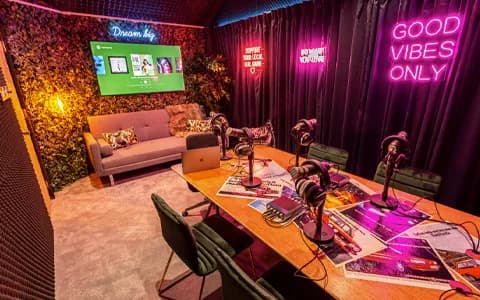
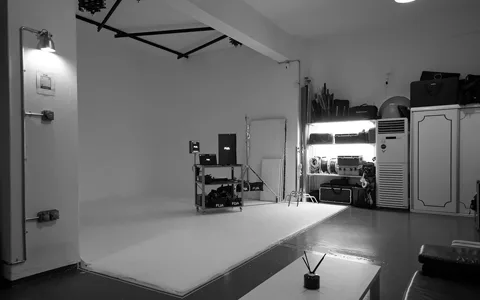
One version is the agency with its own small, in-house studio. This setup is excellent for quick-turn social content, product shots, or podcast records. Another, more robust version is the agency that forms a deep, exclusive partnership with a full-service creative studio. This gives the agency access to high-end gear and specialized talent without the massive capital expense. The agency's creative director can be on set, part of the process, a guardian of the idea.
The Integration's Obvious Benefits
Good things happen when an agency closes the gap between strategy and production. First, creative control stays with the people who had the original vision. The idea remains pure. Those subtle nuances that make a campaign special have a much better chance of surviving the production process.
Second, there's financial efficiency. A bundled approach to strategy and production removes redundant management layers and third-party markups. The client’s budget goes onto the screen, not into administrative overhead. And finally, there's speed. Moving an idea from a sketch on a whiteboard to a live asset in days, not months, is a substantial competitive edge.
A Few Inherent Challenges
This transition is a significant operational lift. It demands a new mindset. An agency's culture has to change from a pure "ideas" factory to a "maker" space. Agency people need to learn the language of production. Production people need to understand the nuances of brand strategy. It's a two-way street.
There’s also the question of investment. The construction of a professional studio is a serious capital expenditure. The equipment, the space, the talent—it all adds up. A deep partnership with an existing high-end studio is often the most brilliant first move. It allows an agency to test the waters and build a new workflow without the immediate financial burden.
The shift is undeniable. Agencies are moving away from the old, fragmented model. They are moving toward a new reality of integration, control, and creative ownership. The ones that master this new hybrid approach will be the ones that define the next decade for their clients and for the industry itself.